
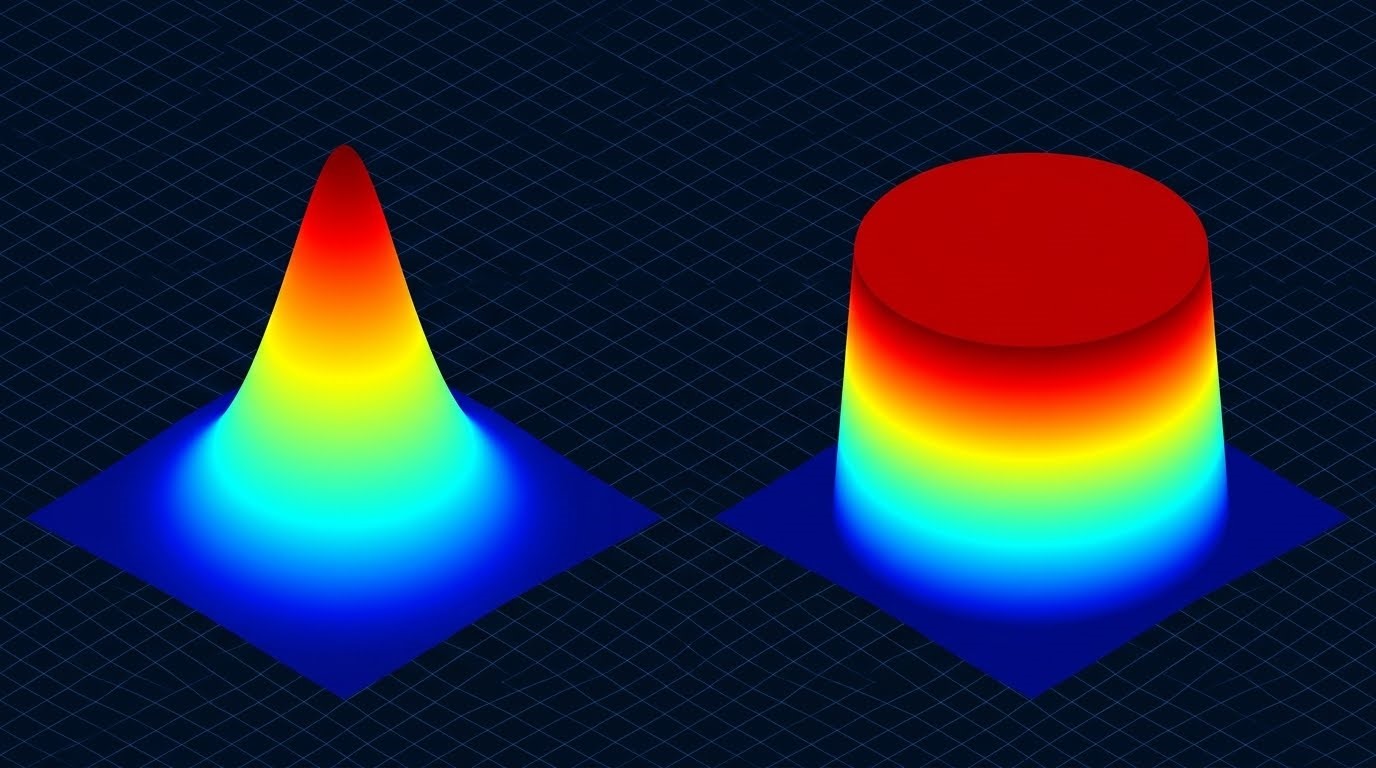
At a glance
- Gaussian: Energy is concentrated in the beam center and falls off in a bell shape toward the edge. Robust, inexpensive, easy to focus.
- Top-hat (flat-top): Nearly uniform energy density across the entire spot, steep edges. The goal: even removal without overheating in the center.
- For cleaning, the edge counts: With a Gaussian beam, the energy density at the edge is often not enough for removal while it is too high in the center. This produces streaks or damage to the substrate.
- Top-hat is not a sure thing: The profile is flat only in a certain plane and reacts sensitively to beam quality, distance and contamination.
- Decide by task: Sensitive substrates and area cleaning tend to benefit from top-hat, robust tasks and long working distances from the Gaussian beam.
What distinguishes the profiles
The beam profile describes how the laser energy is distributed over the cross-section. An ideal Gaussian beam has its maximum in the center and falls off continuously toward the outside. A top-hat beam has a plateau with steep edges: ideally, every point of the spot receives the same energy density.
This matters for laser cleaning because removal is tied to a threshold: below a material-dependent energy density (fluence, J/cm²) nothing happens, above it material is removed, and well above it the substrate is damaged.
What this means in practice
| Criterion | Gaussian | Top-hat |
|---|---|---|
| Energy distribution | Peak in the center, falling off toward the edge | Uniform across the spot |
| Removal pattern | Effective zone smaller than the spot, risk of streaks | Entire spot effective, even removal |
| Risk to the substrate | Peak in the center can exceed the threshold | Lower when the fluence is just above the removal threshold |
| Focus and depth of field | Good, stable over a range | Profile holds only near the image plane |
| Setup | Simple, low cost | Additional optics (homogenizer, beam shaper) |
| Sensitivity | Tolerant | Reacts to input beam, alignment, contamination |
What you need to see soberly
A flat-top is not a property the beam keeps freely in space. Outside the plane for which the beam shaping is designed, the profile changes through diffraction. Steeper edges also mean a higher beam propagation factor (M²) of the shaped beam. Manufacturers advertise clearly better results. Independent technical sources and studies show the advantage mainly where very uniform area treatment and gentle removal are required, and less for simple, robust tasks.
With handheld units there is more: the operator never holds the distance exactly. A top-hat that is ideal in only one plane then loses part of its advantage.
Decision guide
- Prefer top-hat: Thin coatings, sensitive substrates (aluminum, molds, cultural heritage), requirement for a uniform cleaning result, fixed optics with a defined distance.
- Prefer Gaussian: Heavy rust or paint layers, robust steel parts, changing working distances, handheld operation in rough environments, cost-conscious procurement.
- When in doubt, test: Clean samples of your own parts with both configurations and compare removal pattern, roughness and time required.
Sources
- RP Photonics, Encyclopedia of Laser Physics and Technology (flat-top beams, beam shaping): rp-photonics.com
- Edmund Optics, technical notes on beam shaping and Gaussian-to-top-hat conversion: edmundoptics.com
- Le et al., 2020, study on the influence of beam profile on laser processing (technical publication)
Last updated: October 20, 2026