At a glance
- Not pulse energy alone: What matters is the energy density (fluence) on the surface, that is, energy per area.
- More energy often means a larger spot with the same optics: The energy density then rises less than expected, because the area grows too.
- An optimum, not a maximum: Below the removal threshold nothing happens; far above it, the heat input increases and the substrate suffers.
- Frequency counts too: A high pulse rate at high energy leads to heat accumulation. Average power is not the whole picture.
- Choose by task: Consider fluence, spot size and pulse rate together, not just the data sheet maximum.
From pulse energy to energy density
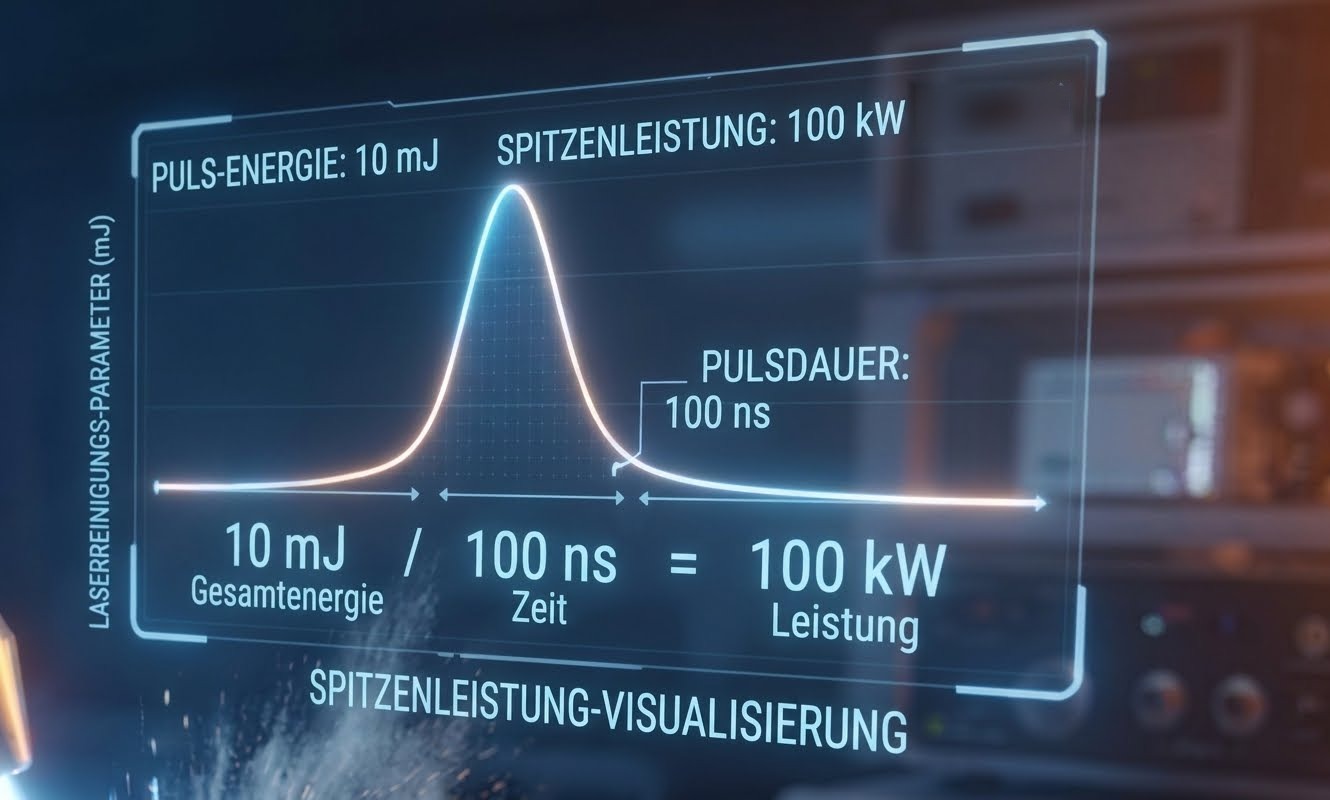
The pulse energy E (in mJ) tells you how much energy a single pulse carries. Removal happens, however, where the energy per area exceeds a threshold. Fluence is calculated as F = E / A, for a round spot with radius r as F = E / (π r²), given in J/cm².
Example: 50 mJ on a spot with a diameter of 1 mm (A ≈ 0.0079 cm²) gives about 6.4 J/cm². If the spot area doubles at the same energy, the fluence is halved. That is why pulse energy alone says little.
Why more pulse energy does not automatically mean more removal
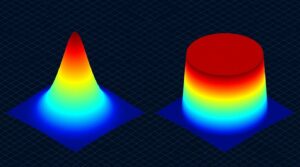
- Spot size grows too: In many devices with fixed optics, higher pulse energies come with larger beam cross-sections. The result is a wider track, but not necessarily a higher fluence.
- Removal threshold: Rust, paint or oxide have different thresholds. If the fluence is too low, there is no removal. If it is too high, the substrate is melted or roughened.
- Heat accumulation: High energy at a high pulse rate leaves the material no time to cool down. Average power rises, heat accumulates, discoloration and distortion threaten.
- An optimum exists: In a study in Frontiers (2025), the best result was at an average pulse energy of around 20 mJ. Higher values brought no advantage. Concrete figures apply only to the material and setup studied.
What three energy levels show
Comparing devices with 15, 50 and 100 mJ gives a typical picture: the lower level works precisely and protects the substrate, but is slow on thick layers. The middle level covers most tasks. The high level removes thick layers quickly but requires more experience, careful parameter selection and stronger cooling. What matters in each case is which fluence arrives at the workpiece.
| Level | Typical use | Points to note |
|---|---|---|
| Low (approx. 15 mJ) | Thin layers, sensitive parts, precision work | Low area rate on thick deposits |
| Medium (approx. 50 mJ) | Rust, paint, oxides on steel, all-round use | Match parameters to the material |
| High (approx. 100 mJ) | Thick layers, large areas, industry | Heat input, substrate protection, cooling |
The levels are guideline values. Removal thresholds differ significantly depending on material and layer thickness, as publications in Chinese Journal of Lasers and Springer technical books also show.
What to look for when choosing
- Ask for the fluence at the workpiece: Not just pulse energy and power, but spot size and beam profile.
- Check the adjustment ranges: A device with a wide parameter window (energy, frequency, spot width) is more flexible than one with a single maximum value.
- Trial cleaning: Test your own parts with two or three settings and compare removal, surface and time.
- Know the substrate: Aluminum and thin sheets tolerate less heat input than thick steel.
Sources
- Frontiers (2025), study on pulse energy in laser cleaning, optimum at around 20 mJ: frontiersin.org
- Chinese Journal of Lasers, work on removal thresholds in laser cleaning: researching.cn
- Springer, technical literature on laser-material interaction and heat accumulation: link.springer.com
Last updated: November 5, 2026