
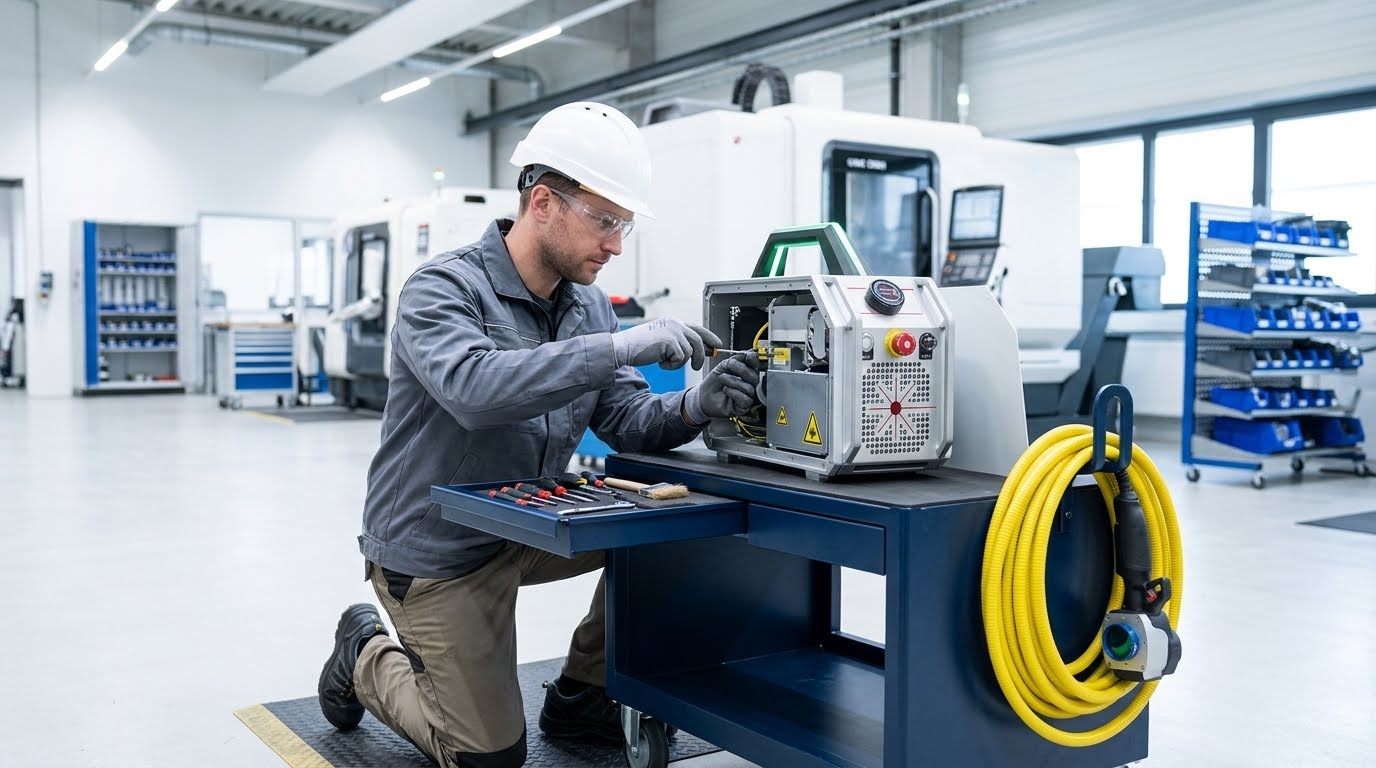
At a glance
- Optics first. Dirt on the protective lens or lens absorbs laser energy and can destroy the optics.
- Protect the fiber cable. Observe the bend radius, keep connectors clean and closed.
- Take cooling seriously. Only distilled or deionized water, temperature above the dew point, clean filters and cooler.
- Safety is part of maintenance. Class 4, extraction, door contact and laser safety officer apply after every service, too.
- The manufacturer decides. Intervals, cleaning agents and work on the laser source follow the manufacturer’s instructions.
Protective lens and optics
The protective lens sits in front of the focusing lens and catches smoke, particles and removal residue. It is a wear part that you inspect and replace when needed. Why this matters is explained in a manual from the industrial laser manufacturer Novanta: even a little dirt on the output window or another optic in the beam path can absorb enough energy to damage the optic. The higher the power density, the more sensitively the optic reacts.
- Inspect the optics for dirt, scratches and burn marks before switching on and regularly during operation.
- Work with powder-free gloves, touch only the edge, never touch the coated surface and do not place tools on the optic. Infrared optics are more sensitive than ordinary glass.
- Change the protective lens in a clean, low-dust environment, not in the workshop. Dust in the optics housing can cause consequential damage.
- In dusty environments, purge the optics with filtered air or nitrogen so that vapors and particles cannot settle.
Fiber cable and connectors
The fiber cable carries the laser radiation from the source to the handheld unit or scanner. It tolerates no kinks and no tight bend radius. If there is a kink or knot in the cable, do not pull on it, because the loop would tighten and fall below the minimum bend radius. Check cables in places with a lot of movement particularly often and route them so that nobody drives or steps on them.
Even more delicate is the end face of the connector. Contamination there traps laser light and converts it into concentrated heat, up to 1000 °C according to Laser Focus World. This can cause defects or small holes in the fiber core. Hence the rule: store connectors only with the dust cap on and open them only according to the manufacturer’s instructions. If cleaning is necessary, use the wet-dry method with optical cleaning fluid and lint-free wipes, never wipe dry.
Cooling system
The laser source converts a lot of electrical energy into radiation and heat. If cooling fails or works poorly, the system throttles or shuts down, and in extreme cases the source is damaged. The following belongs in every maintenance routine:
- Coolant. Use only distilled or deionized water, no tap water. Minerals deposit as limescale and narrow the cooling channels. Additives against algae and corrosion only as specified by the manufacturer. With copper lines the pH value must be above 7.
- Dew point. The coolant temperature must be above the dew point of the room air. Otherwise condensation forms in the housing and on optics. The risk is greatest in heat and high humidity, or when coolant keeps flowing after switch-off.
- Flow, hoses, filters, cooler. Check hoses for leaks and kinks, clean air filters and the recooler. In case of water leaks, switch off immediately.
Safety and extraction
According to Suva, handheld laser cleaning devices always belong to laser class 4. The beam and its reflections endanger eyes and skin, and it is often invisible. Depending on the material, reflections during laser cleaning can cause eye damage even at a greater distance from the processing point. For operation, Suva requires a marked laser controlled area with a door contact on the safety system, effective extraction of hazardous substances, certified protective equipment and a trained person as laser safety officer.
For maintenance this means: extraction is part of the system. Replace filters as specified by the manufacturer and document their condition. Test door contact, emergency stop and warning lights after every service and at fixed intervals. And the laser source stays closed; work on the housing is a matter for the manufacturer.
Store dry and clean
Moisture, dust and metal abrasion do not belong in the laser source, controller or power supply. Store and operate the system in a dry, clean place, wipe external surfaces regularly and keep ventilation inlets free.
Software and firmware
The controller monitors power, temperature and safety functions. Install updates only if the manufacturer has released them and the version is documented. Be particularly careful with changes that affect safety interlocks or power limits. This is not a hobby project.
Professional service
Regular checks by the operator do not replace service by specialists. A technician checks beam quality, power, cooling circuit and safety functions with measuring equipment, detects faults early and logs the condition. In Switzerland, the operating manual of a laser cleaning system must contain information on maintenance and servicing and be available in a national language.
Maintenance plan to take away
| Interval | Task | Who |
|---|---|---|
| Before every shift | Inspect protective lens, visually check cables and connectors, check coolant level and temperature, check extraction | Operator |
| Weekly | Clean optics, check hoses and air filters, wipe external surfaces | Operator |
| Monthly | Check coolant quality, inspect extraction filters, test door contact and emergency stop | Operator, laser safety officer |
| Annually or as specified | Service with power measurement, cooling circuit, safety functions, software | Manufacturer or authorized service |
The intervals are customary guideline values. The specifications of your laser cleaning system’s manufacturer are binding.
Sources
- Suva: Handheld laser welding and laser cleaning, safe use (in German)
- Novanta: v40 User Manual, Cleaning Guidelines and Cooling
- Laser Focus World: Clean fiber optics are critical for laser performance and to prevent damage
- CERN: General handling guidelines for fiber optic cables
- Mazak: Maintenance Recommendations for Fiber Lasers
- Iradion: Infinity 1510 Operator’s Manual (coolant)
Last updated: September 22, 2026