At a glance
- Absorption determines removal rate. What the coating absorbs turns into heat and removes it. What it reflects has no effect.
- It is measured at 1064 nm, not in visible light. Fiber lasers work in the near infrared, and pigments behave differently there than they appear to the eye.
- Black is not always black. Carbon black absorbs almost everything. So-called IR-reflective black pigments look deep black yet still reflect a large share of near-infrared radiation.
- White needs more energy, not more force. Titanium dioxide reflects strongly. More passes and adapted pulse parameters solve this without endangering the substrate.
- Always start with a test area. Every paint, every batch and every age behaves differently.
The physics behind it: absorption, not color
In laser cleaning, a pulsed fiber laser at around 1064 nm hits the coating. The layer absorbs part of the energy and heats up abruptly. It vaporizes or is blasted off as particles, which is known as ablation. Part of the radiation is reflected, part penetrates the layer. Only the absorbed share does work. A study by the University of Turku on removing paint from ship steel with a 100 W nanosecond laser at 1064 nm describes the same: the paint absorbs the energy, vaporizes and is removed layer by layer.
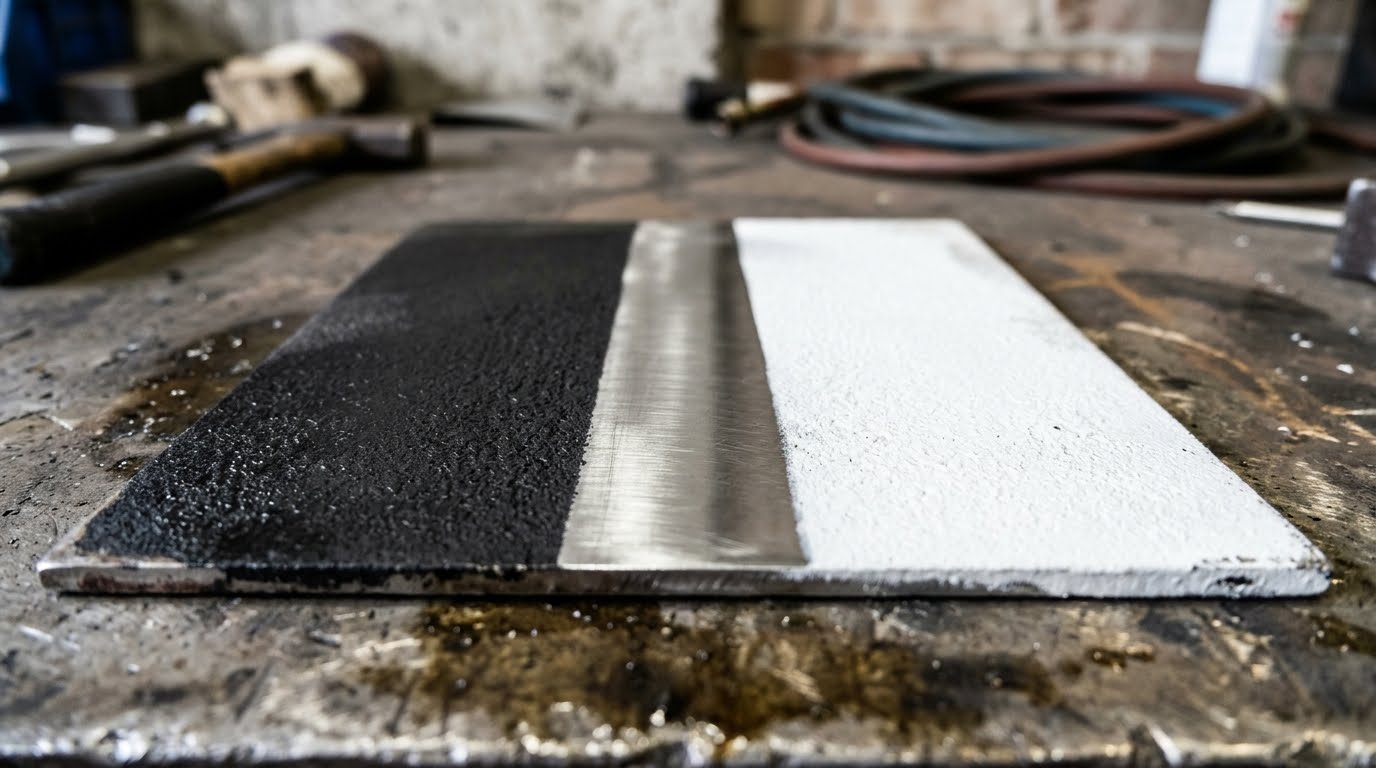
Dark pigments absorb almost everything in the visible range. With carbon black this also holds in the near infrared: the paint absorbs roughly 90 to 95 percent of solar energy and heats up accordingly. White paints usually contain titanium dioxide. It reflects more than 90 percent of the radiation between about 700 and 1300 nm, exactly the window in which the laser wavelength lies. A white paint therefore needs more energy per area, that is, more passes or more power.
The substrate plays a part. Bare metal reflects very differently at 1064 nm depending on the material. The behavior of the coating and the substrate together defines the window in which selective removal is possible.
| Material | Near-infrared reflection |
|---|---|
| White coating with titanium dioxide | over 90% (700 to 1300 nm) |
| Carbon-black coating | 5 to 10% total reflection of the solar spectrum |
| Iron, bare | 62.6% at 1064 nm |
| Zinc, bare | 88% at 1064 nm |
| Copper, bare | 97.3% at 1064 nm |
Sources: PCI Magazine for coatings, Photonics.com for metals. The coating values are measurements on heat-protection paint films and apply approximately, not exactly, at 1064 nm.
Where the rule of thumb fails
The rule “black absorbs, white reflects” applies to visible light. The laser works in the near infrared. Four exceptions occur regularly in practice.
- IR-reflective black pigments. They are developed for cool roof paints and facades: deep black to the eye, but highly reflective in the near infrared. If such a pigment replaces carbon black, the paint’s reflection rises, according to manufacturers, from under 5 percent to 20 to 40 percent. A deep black paint can therefore be slower to clean than its color suggests.
- Transparent or semi-transparent layers. Thick, non-metallic paints and epoxy metal-powder systems let much of the radiation pass through. The layer itself then absorbs little energy, and the result depends strongly on the substrate.
- Multilayer systems. In the Turku study, one system consisted of five layers in bronze, aluminum, light grey, black and red. For thick layers the authors found hardly any change to the steel surface, because the layer absorbs most of the energy. Each layer behaves differently; pigment, layer thickness and adhesion decide.
- The substrate. Bare, reflective metals such as zinc, aluminum or copper require careful parameter selection, because the substrate itself throws back a lot of energy.
The pulse parameters are part of the answer too. Pulse duration, repetition rate, focus diameter, scan speed and overlap determine how much energy per area arrives. The Turku study worked at 25 W with 25 ns pulses, 100 kHz, 450 mm/s and 25 percent overlap, and ran four or eight passes depending on the layer structure. These are test values on ship steel, not a recommendation for your laser cleaning system.
What this means in practice
- Clarify the coating. Which system is on the part, how many layers, what thickness? The paint’s data sheet lists pigments and layer structure; the manufacturer’s answer is often faster than any trial.
- Set up a test area. A small area in an inconspicuous spot; raise the parameters step by step, inspect the result and compare it with the standard requirement. Measure the time per square meter, it is the basis of your calculation.
- Parameters first, then power. For light-colored paints, optimize pulse energy, overlap and scan speed first before using more laser power. More power means more heat input into the substrate.
- Never calculate light and dark paint the same way. An aircraft, a tank and a railway car side each need their own area rates.
- Plan extraction and protection. Depending on the paint, smoke and particles are produced; with old coatings containing lead or chromates, additional protective measures are needed. The laser is Class 4, a laser safety officer is mandatory.
There is no universal figure for how much faster dark paints are removed. Only a trial on the actual part is binding.
Sources
- Tourunen, Väisänen, Iizuka, Peuronen, Kamboj, Piili, Salminen (University of Turku, 2025): Effect of Laser Cleaning on EH36 Steel Surface Quality in Maritime Industry Applications, IOP Conf. Ser.: Mater. Sci. Eng. 1332, 012020
- PCI Magazine: Infrared Colorants for Cool Coatings
- Photonics.com: Laser Cleaning Techniques in Industrial Applications
- SpecialChem: IR-reflective black pigments (manufacturer data)
- Lawrence Berkeley National Laboratory: Pigment Database, for further reading
Last updated: September 8, 2026